
Carbon steel fluoropolymer-lined tees: The Complete Guide for Corrosive Chemical and Industrial Piping Systems
Over the years, I have worked with countless chemical processing systems, semiconductor facilities, and pharmaceutical production lines. One challenge consistently appears in nearly every project:
How do we safely split, combine, or redirect highly corrosive fluids without damaging the piping system?
The answer often comes down to selecting the right pipe fitting, and one of the most reliable solutions is the carbon steel fluoropolymer-lined tee.
At first glance, a tee fitting may seem like a simple component. However, in aggressive chemical environments, it plays a critical role in maintaining process safety, flow efficiency, and equipment longevity.
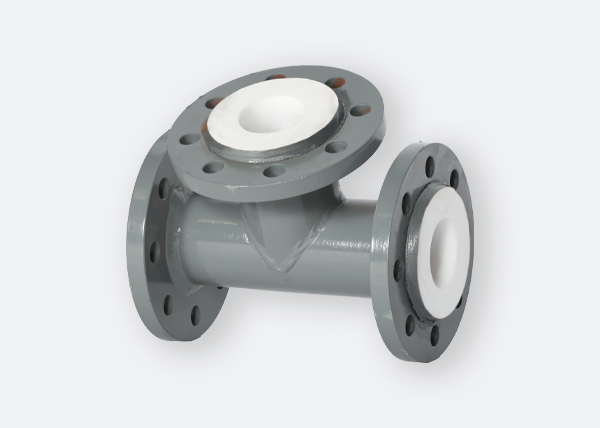
A carbon steel fluoropolymer-lined tee combines the mechanical strength of carbon steel with the outstanding corrosion resistance of fluoropolymer linings such as PTFE, PFA, FEP, or ETFE. This unique combination makes it a preferred choice in industries where conventional metal fittings fail prematurely.
In this guide, I will share practical insights from a manufacturer’s perspective, explaining how carbon steel fluoropolymer-lined tees work, where they are used, and how to choose the right solution for demanding industrial applications.
What Are Carbon Steel Fluoropolymer-Lined Tees?
Why Fluoropolymer Linings Matter
Main Functions of a Fluoropolymer-Lined Tee
Industrial Applications and Real-World Examples
Comparison of Fluoropolymer Lining Materials
How to Select the Right Carbon Steel Fluoropolymer-Lined Tee
Installation and Maintenance Best Practices
Frequently Asked Questions
A carbon steel fluoropolymer-lined tee is a specialized pipe fitting designed to connect three sections of piping while protecting the system from corrosion.
The outer body is manufactured from carbon steel, providing:
High mechanical strength
Structural stability
Pressure resistance
Long service life
The internal surface is lined with a fluoropolymer material that isolates the process fluid from the metal body.
I often explain it to customers this way:
Carbon steel provides the strength, while the fluoropolymer lining provides the chemical protection.
This combination allows the fitting to withstand harsh operating conditions that would quickly damage ordinary steel components.
Corrosion is one of the most expensive problems in industrial piping systems.
Many aggressive chemicals can attack metals, leading to:
Equipment failure
Product contamination
Safety hazards
Unplanned shutdowns
Fluoropolymer linings solve this problem.
Excellent chemical resistance
High temperature tolerance
Smooth non-stick surface
Reduced maintenance requirements
Long operating life
| Property | PTFE | PFA | FEP |
|---|---|---|---|
| Chemical Resistance | Excellent | Excellent | Very Good |
| Maximum Temperature | 260°C | 260°C | 205°C |
| Surface Smoothness | Excellent | Excellent | Excellent |
| Flexibility | Moderate | Good | Very Good |
Source: ASTM Fluoropolymer Standards and Industrial Plastics Engineering Handbook, 2024.
In highly corrosive environments, fluoropolymer-lined fittings can dramatically extend equipment life.
Many people assume a tee simply connects pipes.
In reality, a carbon steel fluoropolymer-lined tee can perform several important functions.
The tee can divide one process stream into two or more separate flow paths.
Typical examples include:
Chemical distribution systems
Utility supply networks
Process branching systems
Multiple process streams can merge into a single outlet.
Common applications:
Reactor feed systems
Mixing stations
Collection headers
The tee can facilitate controlled mixing of different process fluids.
Examples include:
Chemical reactions
Dosing systems
Treatment processes
In some systems, tees help direct different streams toward separate destinations.
This flexibility makes them essential components in modern process plants.
I have seen carbon steel fluoropolymer-lined tees installed in a wide range of industries.
Used for:
Acid transfer lines
Alkali distribution systems
Solvent handling systems
Common chemicals include:
Sulfuric acid
Hydrochloric acid
Nitric acid
Sodium hydroxide
Applications include:
Chemical dosing systems
Purified water distribution
Process fluid routing
Widely used for:
Wet chemical delivery
High-purity process systems
Specialty chemical transport
Used in:
Corrosive service pipelines
Chemical injection systems
Process control networks
One chemical customer replaced standard carbon steel tees with fluoropolymer-lined tees and significantly reduced corrosion-related maintenance over several years of operation.
Not all fluoropolymer linings perform exactly the same.
Choosing the right material depends on process conditions.
| Material | Chemical Resistance | Temperature Resistance | Purity Level | Typical Application |
|---|---|---|---|---|
| PTFE | Excellent | Excellent | High | General chemical service |
| PFA | Excellent | Excellent | Very High | Semiconductor industry |
| FEP | Very Good | Good | High | Moderate temperature systems |
| ETFE | Good | Good | Medium | Mechanical wear environments |
Source: Industrial Corrosion Engineering Guide, 2024.
From my experience, PTFE and PFA are the most common choices for demanding chemical processing systems.
Selecting the proper tee requires more than simply matching pipe sizes.
Consider:
Chemical type
Concentration
Process conditions
Always verify compatibility before selection.
Different fluoropolymers have different temperature limits.
Higher temperatures may require PTFE or PFA linings.
Pressure affects:
Tee design
Wall thickness
Connection method
Evaluate:
Flow direction
Mixing requirements
Distribution needs
Common options include:
Flanged connections
Welded connections
Customized process connections
Proper selection improves both reliability and operating efficiency.
Even premium-quality fittings require proper installation.
I always recommend:
Align piping accurately
Avoid excessive mechanical stress
Follow torque specifications
Inspect linings before installation
Regular inspections should include:
Visual checks
Leak inspections
Connection integrity verification
Lining condition assessment
Pipe misalignment
Excessive bolt tightening
Unsupported piping loads
Improper thermal expansion allowances
Most failures are caused by installation errors rather than material defects.
It is used to divide, combine, mix, or redirect corrosive process fluids in industrial piping systems.
Fluoropolymer linings offer significantly better resistance to many aggressive chemicals.
Chemical processing, pharmaceuticals, semiconductors, petrochemicals, and electronic chemical manufacturing.
Yes. PTFE and PFA linings can typically withstand temperatures up to approximately 260°C.
PTFE remains one of the most widely used fluoropolymer lining materials due to its excellent chemical resistance and temperature performance.
Based on my experience in fluoropolymer equipment manufacturing, carbon steel fluoropolymer-lined tees provide one of the most reliable solutions for handling corrosive process fluids.
Their ability to combine the strength of carbon steel with the exceptional chemical resistance of fluoropolymers makes them indispensable in modern industrial piping systems.
At Jiangsu JIECHUANG New Materials Co., Ltd., we continue to develop advanced fluoropolymer-lined piping systems, valves, storage tanks, and turnkey engineering solutions for customers in chemical processing, semiconductors, pharmaceuticals, and electronic chemicals.
 RELATED
Address: No. 1 Jingpohu Road, Suqian-Suzhou Industrial Park, Suqian City, Jiangsu Province
Xu Hao: 13813955525
Xu Gang: 15189058237
E-mail: zhaojiguang@jsjcxcl.com.cn


Copyright © 2023 Jiangsu Jiechuang New Materials Co., Ltd sitemap
This website uses cookies to ensure you get the best experience on our website.

 Pусский
 日本語
日本語 한국어
한국어 हिन्दी



 WhatsApp
 Phone
Phone