
Fluorine-lined Sight Glasses and Sight Cups: A Complete Industrial Guide for Safe Process Observation
Have you ever faced uncertainty in chemical processing because you couldn’t clearly observe what is happening inside a corrosive pipeline or reactor?
In my experience working with fluoropolymer-lined equipment systems, process visibility is often underestimated. Yet in real industrial production—especially in chemical, semiconductor, and high-purity fluid systems—being able to safely “see inside” the process is critical. That is exactly where Fluorine-lined sight glasses and sight cups become essential.
These components allow operators to visually monitor flow conditions, reaction status, and fluid behavior without opening the system or exposing it to dangerous chemicals. In highly corrosive environments, standard glass or metal viewing ports simply cannot survive. That’s why PTFE-lined solutions have become the industry standard.
In this article, I will explain how fluorine-lined sight glasses and sight cups work, where they are used, how to select them properly, and what real engineering considerations matter most in long-term operation.
On This Page
What Are Fluorine-lined Sight Glasses and Sight Cups?
How They Work in Industrial Systems
Key Advantages of PTFE-lined Observation Equipment
Industrial Applications and Real Use Cases
Material Comparison and Performance Tables
How I Select the Right Sight Glass Solution
Installation and Maintenance Tips
Frequently Asked Questions
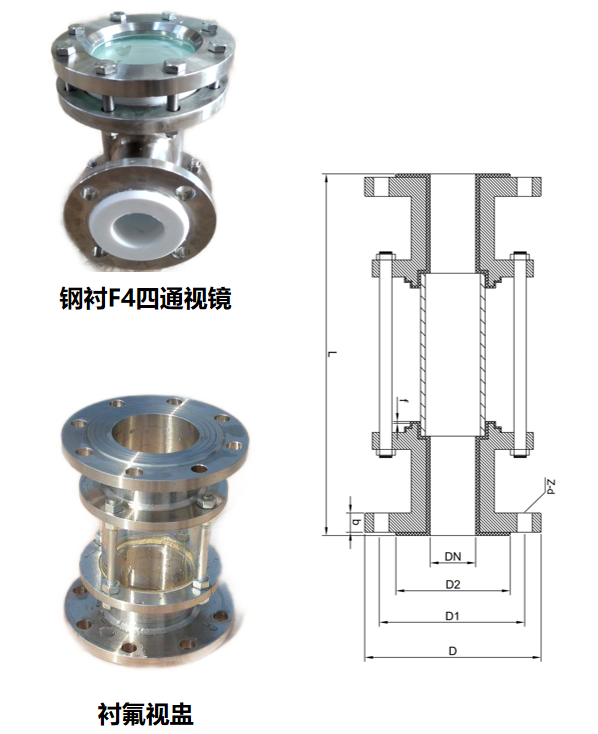
Fluorine-lined sight glasses and sight cups are industrial viewing components installed in pipelines, reactors, and storage systems to allow visual monitoring of process conditions.
They typically consist of:
Steel outer shell (carbon steel or stainless steel)
PTFE (polytetrafluoroethylene) lining
Transparent glass or reinforced viewing window
Sealing system for chemical resistance
In simple terms:
They let you safely “look inside” a corrosive process without exposing equipment or operators to risk.
The working principle is simple but very important.
When installed in a pipeline or reactor:
Fluid flows through the system
The viewing window provides real-time observation
PTFE lining protects the metal body from corrosion
The sealed structure prevents leakage or chemical exposure
This allows operators to monitor:
Flow stability
Color changes
Bubble formation
Reaction progress
In chemical production, this real-time visibility helps prevent accidents and improve process control.
PTFE lining protects the system from:
Strong acids
Strong alkalis
Organic solvents
Oxidizing agents
Operators can observe reactions without opening the system, reducing exposure risk.
Compared with standard glass fittings, fluorine-lined systems significantly extend operational lifespan.
They perform reliably in:
High temperature environments
Highly corrosive chemical systems
Continuous industrial operation
Used in:
Reactor monitoring
Acid/alkali pipeline observation
Chemical blending systems
Critical for:
High-purity fluid monitoring
Process stability control
Contamination prevention
Used to ensure:
Reaction transparency
Clean production processes
Batch consistency
Applied in:
Waste gas treatment systems
Scrubber monitoring
Liquid treatment pipelines
Used for:
Refining process monitoring
Flow visualization
Safety control systems
| Material Type | Corrosion Resistance | Transparency | Service Life | Cost Level |
|---|---|---|---|---|
| Standard Glass | Medium | High | Low | Low |
| Stainless Steel Window | Medium | Low | Medium | Medium |
| PTFE-lined Sight Glass | Excellent | High | High | Medium-High |
| Quartz Glass System | High | Very High | Medium | High |
Source: Industrial chemical equipment material performance reference manuals and manufacturer engineering data.
| Chemical Type | Standard Glass | PTFE-lined System |
|---|---|---|
| Hydrochloric Acid | Poor | Excellent |
| Sulfuric Acid | Poor | Excellent |
| Sodium Hydroxide | Medium | Excellent |
| Organic Solvents | Medium | Excellent |
Source: Fluoropolymer chemical resistance charts and process engineering handbooks.
| Industry | Standard Sight Glass | PTFE-lined Sight Glass |
|---|---|---|
| Chemical Processing | Limited | Excellent |
| Semiconductor Chemicals | Not Suitable | Excellent |
| Pharmaceutical | Medium | Excellent |
| Waste Treatment | Medium | Excellent |
Source: Industrial process system design standards and engineering case studies.
When I choose Fluorine-lined sight glasses and sight cups for a project, I focus on real operating conditions rather than theoretical specifications.
I always ask:
Is the medium corrosive?
Does it contain solids?
Is it high purity?
Different operating conditions require different structural designs.
Some processes require:
Clear color monitoring
Bubble detection
Reaction phase observation
For aggressive chemical systems, I often recommend solutions similar to those used in Jiangsu Jiexin New Material Co., Ltd. systems.
Safety is always a priority in corrosive environments:
Leak prevention
Pressure resistance
Thermal stability
Install sight glasses in areas with stable flow to avoid turbulence distortion.
Deposits may reduce visibility over time.
Check:
Gaskets
Flange connections
Lining integrity
Glass components should be protected from external force.
Even PTFE-lined systems should be inspected regularly.
It is used for visual monitoring of chemical processes inside pipelines, reactors, and storage systems.
Yes. PTFE-lined systems are highly resistant to strong acids and alkalis.
Yes, if designed according to industrial pressure standards.
Typically 10–20+ years depending on operating conditions.
They are widely used in chemical, semiconductor, pharmaceutical, and environmental industries.
From my engineering experience, Fluorine-lined sight glasses and sight cups are small components with a very big impact. They directly improve process visibility, safety, and operational control in corrosive and high-purity systems.
Whether used in chemical production or semiconductor manufacturing, these components help operators make faster and safer decisions without interrupting the process.
At Jiangsu Jiexin New Material Co., Ltd., we design and manufacture advanced fluoropolymer-lined equipment including sight glasses, storage systems, and process components for global industries. Our focus is always on safety, durability, and long-term reliability.
In real industrial environments, better visibility always means better control—and better control means better production.
 RELATED
Address: No. 1 Jingpohu Road, Suqian-Suzhou Industrial Park, Suqian City, Jiangsu Province
Xu Hao: 13813955525
Xu Gang: 15189058237
E-mail: zhaojiguang@jsjcxcl.com.cn


Copyright © 2023 Jiangsu Jiechuang New Materials Co., Ltd sitemap
This website uses cookies to ensure you get the best experience on our website.

 Pусский
 日本語
日本語 한국어
한국어 हिन्दी



 WhatsApp
 Phone
Phone