
High-Efficiency Exhaust Gas Treatment Unit: A Complete Guide to Cleaner, Safer, and More Efficient Industrial Emission Control
Have you ever wondered what happens to harmful gases after they leave a chemical reactor, semiconductor production line, or industrial manufacturing process?
Many industrial operations generate exhaust gases containing acidic compounds, volatile organic compounds (VOCs), nitrogen oxides (NOx), sulfur compounds, fine particles, and other pollutants. If these gases are released directly into the atmosphere, they can harm the environment, create safety risks, and violate environmental regulations.
This is where a High-Efficiency Exhaust Gas Treatment Unit becomes essential.
As a manufacturer specializing in fluoropolymer-lined equipment, chemical process systems, and exhaust gas treatment solutions, we have worked with customers in semiconductor, electronic chemical, photovoltaic, and specialty gas industries. Through years of project experience, we have seen how the right Exhaust Gas Treatment System can improve environmental compliance, reduce operating risks, and protect valuable production assets.
In this guide, I will explain how exhaust gas treatment units work, where they are used, how to select the right system, and what buyers should consider before investing in an industrial emission control solution.
On This Page
What Is a High-Efficiency Exhaust Gas Treatment Unit?
How Does an Exhaust Gas Treatment Unit Work?
Main Types of Exhaust Gas Treatment Technologies
Applications Across Industries
Benefits of Using a High-Efficiency Exhaust Gas Treatment Unit
How to Choose the Right Exhaust Gas Treatment System
Comparison of Different Treatment Technologies
Maintenance and Operational Best Practices
Frequently Asked Questions
Conclusion
A High-Efficiency Exhaust Gas Treatment Unit is an environmental protection system designed to remove, neutralize, or convert harmful substances contained in industrial exhaust streams before they are released into the atmosphere.
The system may include:
Scrubbers
Reaction chambers
Catalytic reactors
Filtration systems
Adsorption units
Monitoring instruments
Exhaust fans
Control systems
The main purpose is to transform hazardous pollutants into safer compounds that meet environmental discharge requirements.
Depending on the process, exhaust gas treatment units can remove:
Acid gases
Alkaline gases
VOCs
NOx
SOx
Particulate matter
Toxic chemical vapors
Specialty gas by-products
In industries such as semiconductor manufacturing and electronic chemicals, exhaust gas treatment is not only an environmental requirement but also a critical safety measure.
Although system designs vary, most exhaust gas treatment processes involve three key mechanisms.
Oxidation converts harmful gases into more stable compounds.
For example:
Carbon monoxide becomes carbon dioxide.
Hydrogen converts into water vapor.
Certain VOCs are broken down into less harmful substances.
Catalysts are often used to accelerate these reactions while reducing energy consumption.
Reduction technology is commonly used to remove nitrogen oxides (NOx).
Through chemical reactions, NOx compounds are converted into:
Nitrogen gas
Water vapor
This process is widely used in industrial emission control systems.
Some pollutants are captured rather than chemically converted.
Common methods include:
Activated carbon adsorption
Chemical scrubbing
Wet absorption systems
These technologies effectively remove:
Acidic vapors
Organic compounds
Toxic gases
Together, these processes create a comprehensive treatment solution capable of handling complex industrial exhaust streams.
Different pollutants require different treatment approaches.
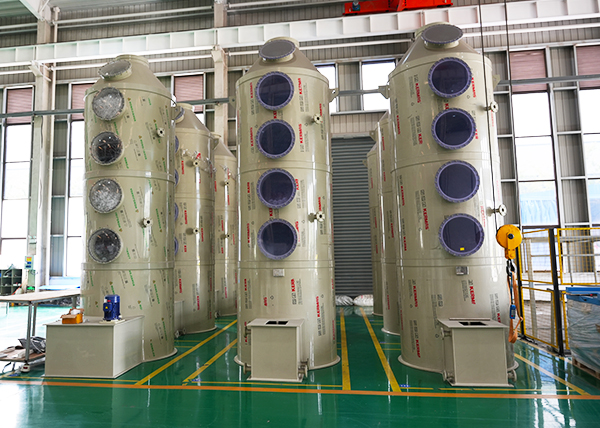
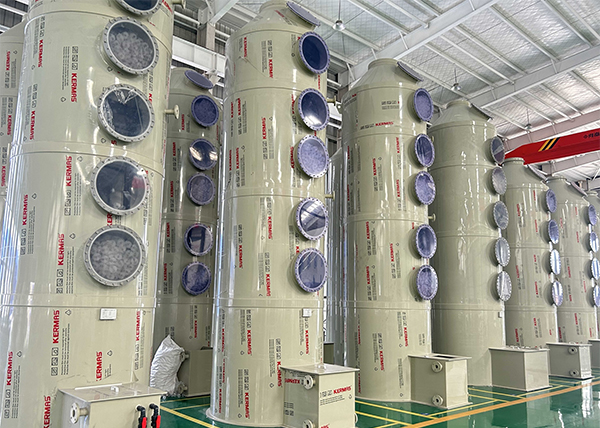
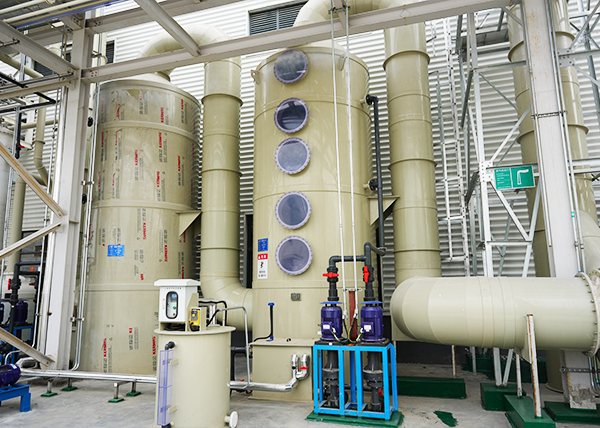
Wet scrubbers use liquid absorbents to remove contaminants from gas streams.
Advantages:
High removal efficiency
Effective for acidic gases
Suitable for corrosive environments
Common applications:
Semiconductor fabs
Chemical plants
Electronic chemical production
Catalysts accelerate chemical reactions that convert harmful gases into harmless compounds.
Advantages:
High efficiency
Lower energy consumption
Stable performance
Common applications:
VOC treatment
NOx reduction
Activated carbon captures pollutants through adsorption.
Advantages:
Simple operation
High VOC removal efficiency
Cost-effective for low concentrations
Thermal oxidizers destroy pollutants using high-temperature combustion.
Advantages:
Very high destruction efficiency
Effective for complex VOC mixtures
This is one of the most demanding applications.
Exhaust gases may contain:
Fluorinated compounds
Acid gases
Specialty gas by-products
High-efficiency treatment systems help maintain environmental compliance and workplace safety.
Electronic-grade chemicals require highly controlled processing environments.
Exhaust gas treatment protects:
Production equipment
Employees
Nearby communities
Chemical plants generate a wide range of exhaust emissions.
Treatment units are commonly used for:
Reactor vent gases
Storage tank emissions
Process exhaust streams
Solar cell manufacturing often generates gases requiring specialized treatment.
These include:
Silane-related emissions
Acidic vapors
Process by-products
Exhaust treatment helps control:
Solvent vapors
VOC emissions
Chemical odors
Many companies initially install treatment systems for regulatory compliance. However, the long-term benefits extend much further.
Reducing harmful emissions supports sustainability goals and environmental responsibility.
Proper exhaust treatment minimizes employee exposure to hazardous substances.
Meeting local and international environmental standards reduces legal risks and potential penalties.
Corrosive gases can damage expensive production equipment.
Treatment systems help extend equipment lifespan.
Customers increasingly prefer suppliers with strong environmental management practices.
Choosing the right solution requires careful evaluation.
Different contaminants require different technologies.
| Pollutant Type | Recommended Technology |
|---|---|
| Acid Gases | Wet Scrubber |
| VOCs | Activated Carbon or Thermal Oxidizer |
| NOx | Catalytic Reduction |
| Particulates | Filtration Systems |
| Mixed Pollutants | Multi-Stage Treatment |
Source: EPA Air Pollution Control Technology Fact Sheets and industrial emission control engineering practices.
Important factors include:
Exhaust volume
Peak operating conditions
Future expansion plans
For aggressive chemicals, materials such as:
PTFE-lined steel
Fluoropolymer-lined vessels
Corrosion-resistant alloys
can significantly improve service life.
Evaluate:
Energy consumption
Chemical usage
Maintenance requirements
Replacement components
| Technology | Removal Efficiency | Capital Cost | Operating Cost | Maintenance |
|---|---|---|---|---|
| Wet Scrubber | High | Medium | Medium | Medium |
| Activated Carbon | Medium-High | Low | Medium | High |
| Catalytic Treatment | High | High | Low | Low |
| Thermal Oxidizer | Very High | High | High | Medium |
Source: Industrial Air Pollution Control Engineering Handbook and environmental equipment supplier performance data.
| Technology | VOCs | Acid Gases | NOx | Particulates |
|---|---|---|---|---|
| Wet Scrubber | Medium | Excellent | Low | Medium |
| Activated Carbon | Excellent | Poor | Poor | Poor |
| Catalytic Reactor | Good | Poor | Excellent | Poor |
| Thermal Oxidizer | Excellent | Poor | Medium | Poor |
Source: Environmental Protection Agency (EPA) technology assessment documents and industrial process emission studies.
Even the most advanced High-Efficiency Exhaust Gas Treatment Unit requires regular maintenance.
Inspect:
Pressure readings
Flow rates
Pump operation
Alarm status
Verify:
Chemical dosing systems
Sensor calibration
Scrubber circulation systems
Review:
Filter condition
Catalyst performance
Corrosion status
Perform:
System integrity testing
Component replacement
Full operational validation
A preventive maintenance strategy often costs far less than emergency repairs and unexpected downtime.
Depending on the design, the system can remove VOCs, acid gases, NOx, sulfur compounds, toxic vapors, and particulate matter.
Yes. Wet scrubbers are widely used in semiconductor manufacturing due to their excellent performance with acidic and corrosive exhaust gases.
With proper maintenance, industrial systems commonly operate for 15–25 years or longer.
Absolutely. Airflow capacity, materials, treatment technologies, automation levels, and monitoring systems can all be customized.
PTFE-Lined Equipment provides excellent corrosion resistance, making it ideal for aggressive chemical environments commonly found in electronic chemical and semiconductor industries.
A High-Efficiency Exhaust Gas Treatment Unit is one of the most important investments for modern industrial facilities seeking safe, sustainable, and compliant operations.
From semiconductor manufacturing and electronic chemicals to chemical processing and photovoltaic production, advanced exhaust treatment technologies help companies reduce emissions, improve safety, protect equipment, and meet increasingly strict environmental standards.
At Jiangsu Jiechuang New Materials Co., Ltd., we combine fluoropolymer equipment manufacturing expertise, process engineering capabilities, and turnkey project experience to provide customized exhaust gas treatment solutions for demanding industrial applications.
Address: No. 1 Jingpohu Road, Suqian-Suzhou Industrial Park, Suqian City, Jiangsu Province
Xu Hao: 13813955525
Xu Gang: 15189058237
E-mail: zhaojiguang@jsjcxcl.com.cn


Copyright © 2023 Jiangsu Jiechuang New Materials Co., Ltd sitemap
This website uses cookies to ensure you get the best experience on our website.

 Pусский
 日本語
日本語 한국어
한국어 हिन्दी



 WhatsApp
 Phone
Phone